
One of the most common frustrations I hear from local business owners is this:
“We have 100+ five-star reviews, yet a competitor with 10–15 reviews consistently outranks us on Google Maps.”
This situation is especially common in local service industries cleaning companies, law firms, healthcare clinics, roofing contractors, and home services across the USA, UK, and Europe.
At first glance, it feels unfair.
More reviews should mean better rankings—right?
Not exactly.
The truth is: Google Maps rankings are not a popularity contest.
They are a relevance and authority calculation.
Reviews Help Conversions — Not Rankings Alone
Customer reviews are extremely valuable. They build trust and influence buying decisions.
But from a ranking perspective, reviews are only one small part of a much bigger system.
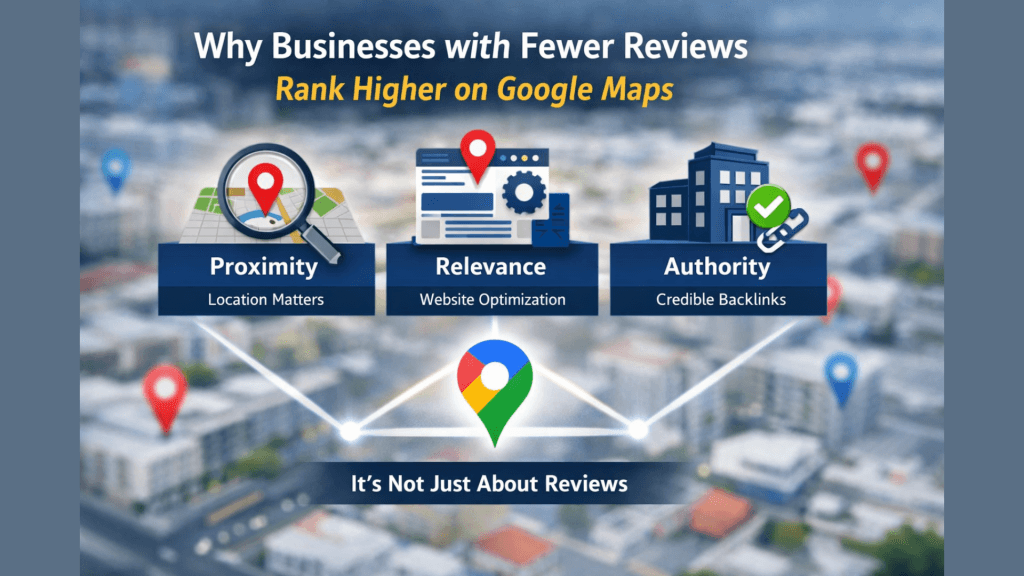
Google’s local algorithm is primarily driven by three core factors:
- Proximity
- Relevance
- Authority
If a competitor with fewer reviews is outranking you, it’s usually because they’ve optimized the other two better than you have.
Let’s break it down.
1. Proximity: The Invisible Advantage You Can’t See
Google’s first question is simple:
“Which business is closest and most relevant to the searcher right now?”
Even if your business has hundreds of reviews, a competitor may rank higher because:
- Their office is closer to the search location
- They have stronger local citations (mentions of their business name, address, and phone number)
- They are consistently referenced within a specific neighborhood or service area
This is why two users searching the same keyword can see different Map Pack results.
Key insight:
You don’t need to be the biggest brand—just the most locally relevant.
2. On-Page Relevance: When Your Website Fails to Support Your Google Profile
Google doesn’t judge your business only by your Google Business Profile.
It evaluates how well your website explains what you actually do.
Many local businesses make this mistake:
- One generic service page
- No location-specific content
- No clear service specialization
Meanwhile, competitors create dedicated, intent-focused pages, such as:
- “Commercial Cleaning Services in Dallas”
- “Emergency Roof Repair in London”
- “Personal Injury Lawyer in Manchester”
- “Private Clinic Interior Design Services”
This creates a tight relevance loop between:
- Search query
- Google Business Profile
- Website content
Google trusts clarity more than praise.
3. Authority: The Ranking Signal Most Local Businesses Ignore
Google sees your business as an entity, not just a listing.
Authority is built when your business is mentioned or linked by:
- Local news websites
- Industry blogs
- Professional directories
- Regional business associations
A business with fewer reviews but strong backlinks and brand mentions often outranks a business with hundreds of reviews and zero authority signals.
Important:
Google trusts who talks about you more than how many people rate you.
Why Review Volume Alone Doesn’t Translate to Visibility
High review counts improve conversion, not guaranteed visibility.
Google Maps rankings reward businesses that:
- Match search intent precisely
- Are geographically relevant
- Demonstrate topical and entity authority
That’s why ranking is not about being the most liked business.
It’s about being the most qualified answer for that specific search at that exact moment.
Final Thought for Local Business Owners
Ask yourself this:
Is your digital presence built to win a popularity contest—or to prove to Google that you are the most relevant and authoritative solution in your area?
If your rankings don’t reflect your reputation, the issue usually isn’t reviews.
It’s strategy.
Let’s turn your website into your best-performing salesperson!
Written by Hasib | Student, CSE @ BUBT | SEO Enthusiast | Digital Growth Learner