
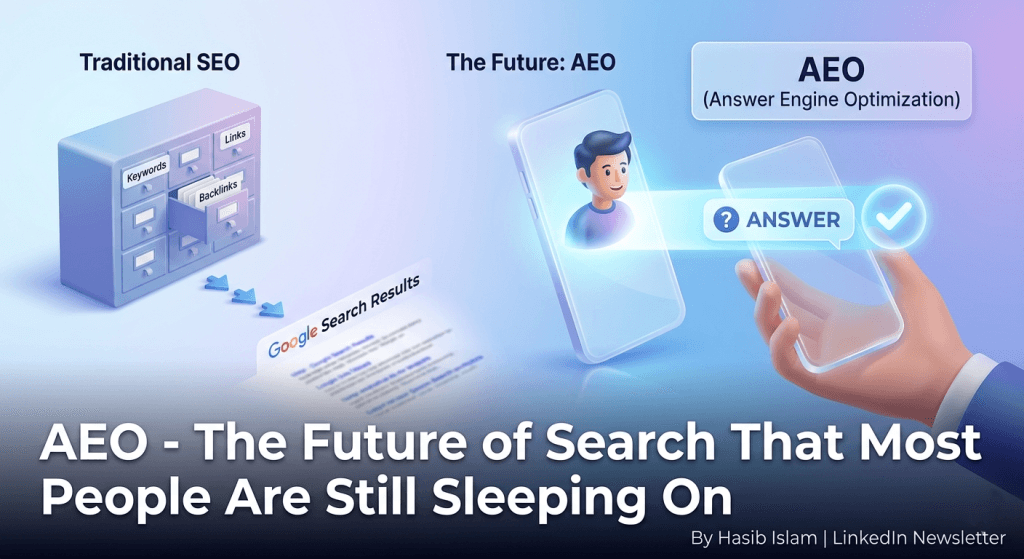
AEO stands for Answer Engine Optimization. SEO gets you ranked. AEO gets you answered.
Traditional SEO was about getting your website to show up on Google’s first page. You’d optimize your content, build backlinks, fix technical stuff — and hopefully, people would click your link.
AEO is different. AEO is about optimizing your content so that search engines — and now AI tools like ChatGPT, Google’s AI Overview, Siri, Alexa, and Bing Copilot — can pull your answer directly and show it to the user. No click needed.
Your business becomes the answer.
Think about that for a second. If someone asks their phone “who’s the best plumber near me?” — wouldn’t you want YOUR business to be the one that gets spoken out loud?
That’s AEO in real life.
Why Is AEO Suddenly So Important?
Here’s what’s happening right now, and most people aren’t paying attention.
Search behavior is changing dramatically.
People used to type keywords. Now they ask questions.
- “Best roofer in Austin Texas”
- “How much does HVAC repair cost?”
- “Who does same-day pest control near me?”
These aren’t keywords. These are conversations.
And search engines have evolved to match that. Google’s AI Overviews, ChatGPT search, Perplexity AI — they don’t just show links anymore. They read through content, understand context, and give direct answers.
So if your content isn’t written in a way that answers questions clearly — you’re invisible.
Not page 2 invisible.
Completely invisible.
That’s the scary part. And that’s why AEO matters more every single day.
AEO vs SEO — Are They Different?
Yes and no.
Think of it this way.
SEO is getting your restaurant listed in a directory. AEO is being the restaurant that the concierge recommends by name when a guest asks.
Both matter. But AEO is where trust lives.
With traditional SEO, you’re competing for clicks. With AEO, you’re competing to be the most trusted, clearest answer in your industry.
Here’s a quick breakdown:
| SEO | AEO | |
|---|---|---|
| Goal | Rank on Google | Be the answer |
| Focus | Keywords & backlinks | Questions & context |
| Result | Website traffic | Direct authority |
| Works on | Google search | Google, AI tools, voice search |
| Future | Getting harder | Getting more important |
The truth? You need both. But in 2026 and beyond, AEO is what separates the businesses that grow from the ones that just survive.
How Does AEO Actually Work?
Okay, this is the part most people skip. Let’s go deep.
When someone asks a question online — whether it’s on Google, ChatGPT, or even Alexa — the AI system does something very specific.
It looks for content that:
1. Directly answers the question Not dances around it. Not hides the answer behind 500 words of fluff. Actually answers it — clearly and quickly.
2. Uses natural, conversational language AI tools are trained on how humans talk. If your content sounds like a robot wrote it, AI won’t trust it. Simple as that.
3. Is structured properly Headers, bullet points, short paragraphs — these aren’t just design choices. They help AI systems understand what your content is about and pull the right section as an answer.
4. Comes from a trusted source Domain authority still matters. But so does consistency, relevance, and how often your content actually helps people.
5. Answers follow-up questions too Not just “what is X” but “how does X work”, “why does X matter”, “how much does X cost.” The more completely you cover a topic, the more likely AI is to use your content as a reference.
So in simple terms — AEO is about writing content the way a helpful expert would explain something to a friend. Clear. Complete. Honest.
What Kind of SEO Do You Need for AEO?
This is where it gets practical. And this is what most blogs don’t tell you.
AEO isn’t a completely separate thing you do. It’s a layer on top of good SEO. But certain SEO tactics become way more important when you’re optimizing for answers.
Here’s what actually moves the needle:
1. Question-Based Keyword Research
Forget just targeting “plumber Austin.” Start thinking about:
- “How much does a plumber cost in Austin?”
- “Why is my water pressure low?”
- “Do I need a plumber or can I fix it myself?”
These are the questions real people ask. And they’re exactly what AI systems are built to answer.
Tools like AnswerThePublic, AlsoAsked, and even Google’s “People Also Ask” section are goldmines for this.
2. FAQ Sections on Every Page
This is underrated and underused.
Every service page, every blog post — end it with a real FAQ section. Not generic stuff. Actual questions your clients ask you. And answer them directly.
Why? Because AI tools love FAQs. They’re pre-packaged answers. Easy to pull, easy to display.
3. Schema Markup (Structured Data)
This one sounds technical. But the concept is simple.
Schema markup is basically a tag you add to your website’s code that tells Google: “Hey, this section is an FAQ. This is a product. This is a review.”
When Google understands your content better, it’s more likely to use it as a featured answer or in AI responses.
For local businesses especially — FAQ schema, LocalBusiness schema, and Service schema are non-negotiable in an AEO world.
4. Conversational Content Writing
This is the biggest shift.
Old SEO content: “Our professional plumbing services offer comprehensive solutions for residential and commercial properties.”
AEO content: “We fix leaks, unblock drains, and install new pipes. Most jobs done same day. Serving Austin and surrounding areas.”
See the difference? One sounds like a brochure. The other sounds like a person.
AI systems — and real humans — trust the second one way more.
Write like you’re explaining something to a smart friend. Not like you’re filling a word count.
5. Featured Snippet Optimization
Featured snippets are those boxes that appear at the top of Google — above all other results.
To win them, you need to:
- Ask the question in your content (as a heading)
- Answer it directly in the next 2-3 sentences
- Keep the answer between 40-60 words
It sounds simple. Because it is. But most websites don’t do it.
6. Voice Search Optimization
35% of US households have a smart speaker. Millions more use voice search on their phones daily.
Voice search is 100% AEO territory.
When someone says “Hey Google, find me a local roofer” — Google picks ONE answer. Not ten links. One.
To win voice search:
- Use natural language in your content
- Answer “near me” type queries
- Make sure your Google Business Profile is fully optimized
- Have your NAP (Name, Address, Phone) consistent everywhere
7. E-E-A-T (Experience, Expertise, Authority, Trust)
Google’s quality guidelines now heavily focus on E-E-A-T.
AI systems don’t just pull any answer. They pull answers from sources they trust.
How do you build that trust?
- Real case studies and results
- Author bio with credentials
- Consistent publishing history
- Real reviews and testimonials
- Backlinks from credible sources
The more you’re seen as a real expert with real experience, the more AI tools will reference you.
AEO for Local Service Businesses — This Is Where It Gets Real
Let me bring this home.
If you run a local business — plumbing, roofing, cleaning, HVAC, landscaping — AEO might be the single biggest opportunity you’re missing right now.
Here’s why.
When someone has an emergency — a pipe burst, a roof leak, a pest problem — they don’t browse. They ask. Voice search. AI tools. Quick Google queries.
“Who can fix my AC today in Dallas?” “Emergency plumber near me open now” “Best pest control for roaches in my area”
If your business is the answer to those questions — you get the call.
Not your competitor who has a prettier website. Not the big franchise with a huge ad budget. You.
That’s the power of AEO for local businesses. It levels the playing field.
A well-optimized local business with smart AEO strategy can absolutely outperform bigger competitors — because you’re more specific, more local, and more relevant to the exact question being asked.
Where Do You Start?
If you’re reading this and thinking “okay this makes sense, but where do I even begin” — here’s a simple starting point:
Step 1: Go to Google and search for your main service. Look at the “People Also Ask” section. Write down every question there.
Step 2: Make sure your website answers those questions — clearly, simply, in plain language.
Step 3: Add an FAQ section to your most important pages.
Step 4: Make sure your Google Business Profile is 100% complete and updated.
Step 5: If you have a blog — write content that answers real questions your customers ask. Not keyword-stuffed fluff. Real answers.
That’s your AEO foundation. Everything else builds from there.
Final Thought
SEO got you this far. But the next wave of search isn’t about rankings.
It’s about being the answer.
The businesses that understand AEO today will dominate search tomorrow. Voice search, AI tools, featured snippets — they all reward the same thing.
Clear. Helpful. Human content.
That’s it. That’s the secret.
No tricks. No hacks. Just being genuinely useful — in a way that both humans and AI can understand.
So the real question is: Is your business ready to be the answer?
Written by Hasib | Student, CSE @ BUBT | SEO Enthusiast | Digital Growth Learner | Helping Local Businesses Improve Google Visibility
Linkdin : Hasib
Instagram : Hasib
AEO helps local businesses appear in voice search results, Google AI Overviews, and featured snippets. When someone asks “best plumber near me,” AEO makes sure your business is the answer Google speaks out loud — not your competitor’s.
The most important AEO tactics are question-based keyword research, FAQ sections on every page, schema markup, conversational content writing, featured snippet optimization, voice search optimization, and building E-E-A-T signals.
No. AEO does not replace SEO — it builds on top of it. You still need good SEO fundamentals like backlinks, technical optimization, and keyword targeting. But AEO adds an extra layer that helps you win in AI-powered and voice search.
Start by finding questions your customers ask using Google’s “People Also Ask” section. Answer those questions clearly on your service pages, add FAQ sections, optimize your Google Business Profile, and write blog content that directly answers real customer questions.